
March 2026 Meetup
Matt delivers the news roundup, Moonbench discusses their catode32 project
News Round-up
Headlines
MicroPython v1.28

MicroPython v1.28 is nearing release. Some of the improvements:
machine.CANlow-level driver added, stm32 to start withmachine.PWMfor stm32- t-strings added
machine.Counterandmachine.Encoderadded to mimxrt (joins ESP32)
Check out Milestone #12 for more!
PyCon AU 2026

PyCon AU 2026 is in Brisbane, August 26-30.
If you’re thinking of attending, the Call for Proposals ends this week on the 29th AOE.
Housekeeping: Luma

Some folks have mentioned they haven’t received notifications for upcoming meetups. Now that we’re using Luma you should subscribe to the ‘overall’ MicroPython Calendar:
You’ll then get an email whenever a new meetup is scheduled and, I think, you’ll get a reminder close to each event.
Note that each meetup also gets a unique page/URL.
I’ve noticed fewer people RSVP’ing to each event since moving to Luma; if you could RSVP that would be really helpful! It’s hard to know if I should be ‘advertising’ it more widely - but at least having a vague idea of how many people are coming gives me an idea about attendance.
Unfortunately (with meetup and Luma) it’s not possible to set up a recurring event with the ‘xth Wednesday of the month’ rule.
Thanks!
Matts New Hardware
M5 Stack StickS3
(Covered in the January 2026 meetup.)
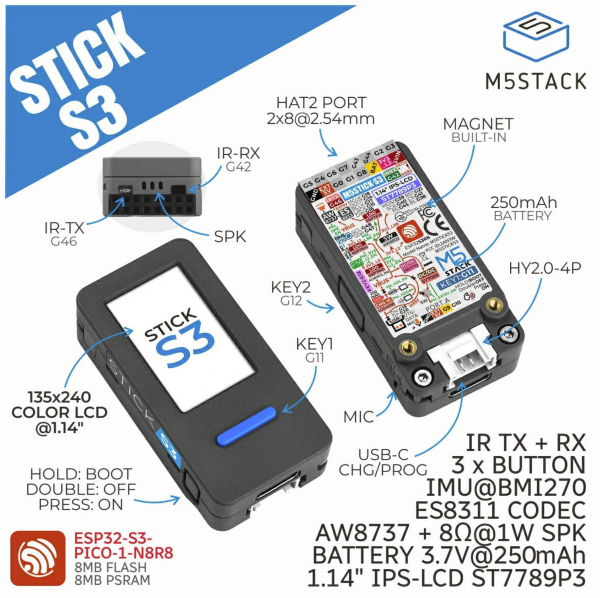
ESP32-S3, 8MB PSRAM, 8MB Flash, 1.14” 135x240 LCD display (ST7789P3).
Mic & speaker (I2S), 6-axis IMU, IR transmitter & receiver, 250mAh battery
OpenMV AE3
(First covered in March 2025.)

An aboslute powerhouse in a tiny package. My first Alif microcontroller.
Seeed XIAO ESP32C6
(May 2024.)
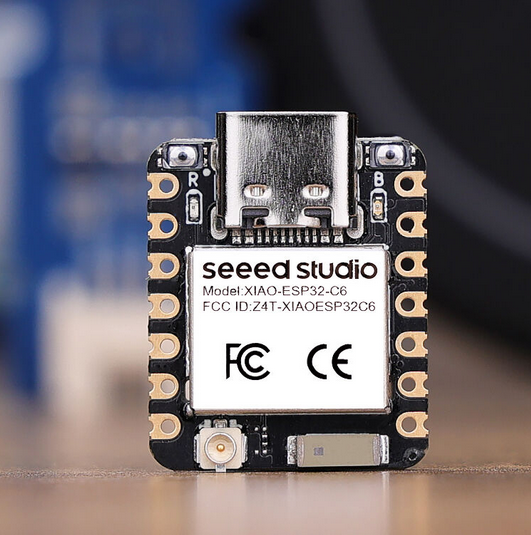
ESP32-C6, 4MB Flash, on-board & external antenna.
Hardware News
STMicro Announces STM32C5 family

STMicro announces STM32C5 family
STMicro launched their latest microcontroller family…and I think they’ll sell these by the bucketload.
They’re positioned as the ‘entry level’ micro but are surprisingly powerful and very affordable.
Some highlights:
- Cortex M33 @ 144MHz
- Up to 1MB flash (at least 128KB)
- Up to 256KB RAM (at least 64KB)
- Rich peripherals: OctoSPI, up to 118x IO, USB, Ethernet, CAN, I2S, I3C, ADC/DAC, more
- 11 different packages: 3x3mm -> 14x14mm
- Wide operating temperature: -40°C to +125°C
Pricing starts at US$0.64 in quantity.
With those features, it’s like they designed the family to target MicroPython!
M5Stack Unit PoE with ESP32-P4

The new Unit PoE with ESP32-P4 is a compact little beast! This ESP32-P4-powered thumb-sized device adds PoE to the mix:
- ESP32-P4, 16MB flash, 32MB PSRAM
- 24 pin FPC breakouts for MIPI DSI and CSI
- 10/100M PoE Ethernet
- 2x USB-C
- Compact: 65x33x21mm
US$21.50
Seeed Studio reTerminal D1001

Seeed Studio have expanded their reTerminal range with the D1001. If you’re looking for a decent microcontroller-powered display this might be it.
- ESP32-P4, 32MB flash, 32MB PSRAM
- 8” 1280x800 cap touch display
- 2MP (1600x1200) camera
- ESP32-C6 for wifi/ble
- Audio stack: dual mic and adc output
- 2500mAh battery
- RTC, 6-axis IMU
Also, Hackster.io: Seeed Studio Targets Next-Gen HMI with the Espressif ESP32-P4-Powered reTerminal D1001
US$85
Dabao
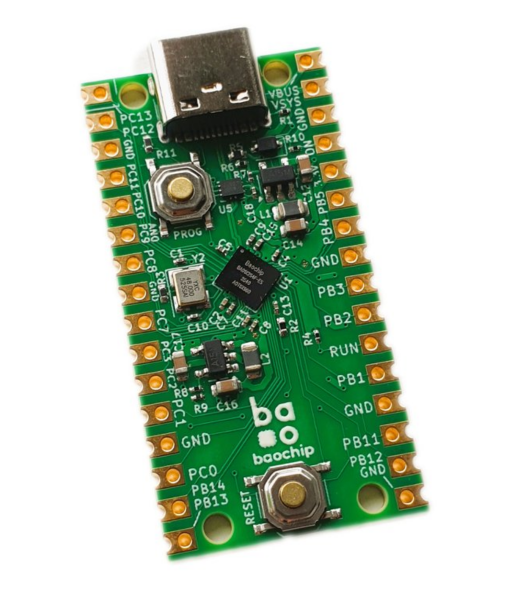
The Dabao was discussed last month, but there’s an excellent article by Bunnie about one of the more unique features of the Bao chip: BIO: The Bao I/O Coprocessor
It’s easy to imagine a MicroPython BIO assembler, similar to that implemented for the Raspberry Pi RP2 PIO module.
Inkplate 13SPECTRA
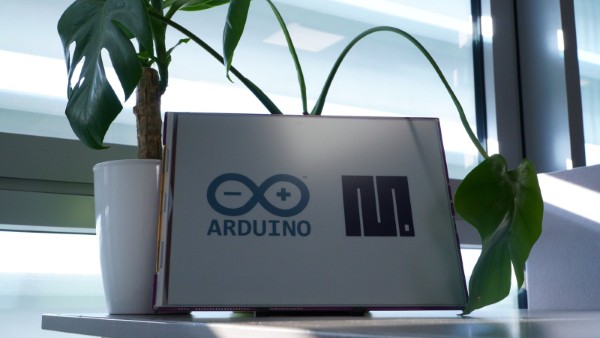
Last month we covered the Inkplate 13SPECTRA, a beautiful six-colour 13” ePaper display.
Soldered recently published their Week Three Status that includes update to the MicroPython library but did mention “because MicroPython is an interpreted language and not very low-level friendly, decoding and displaying a full 1600x1200 image file can take up to a minute.”
Anyone want to prove them wrong?
(Kudos to Soldered for releasing the MicroPython library! But perf can be improved!)
PineTime Pro Watch

Pine64’s March Update announced that the PineTime Pro was in development.
We first covered the original PineTime Watch in September 2019!
Upgrades include:
- AMOLED display
- GPS
- A custom chip (??)
- A digital crown which also features an extra button
- A blood oxygen sensor
- Power management improvements
“More information to come!”
Other news
Amiga port

Fabrice - with LLM assistance - has built a MicroPython port for the Amiga (Motorola 68K): micropython-amiga-port. It looks remarkably complete!
via Amiga News.de.
This isn’t the first Amiga port we’ve come across, we covered micropython-amiga back in August 2024
PyBricks - now with ‘LEGO Vision’

Laurens Valk teases a new feature for PyBricks; Vision!
Use a smartphone to process images in realtime and communicate details to a PyBricks hub. The current example uses colour tracking so a robot can follow a coloured ball - but Laurens mentioned “…there are more demos on the way”.
Agentic Test Bench
Provide Claude with the ability (via scope-mcp) to communicate with your (admittedly pricey) oscilloscope and then have your agent verify that I2C timing is correct!
Uses MicroPython to generate the I2C signals, of course.
MicroPython ePaper Weather Station

Frederik Andersen seems to have started the micropython-ePaperWeatherStation project but Daniel Kharlamov appears to have updated it recently…in any case, it’s a nice looking ePaper Weather Station!
micropython-usunfish

Sunfish is a popular Chess engine known for it’s power, particularly given it’s simple implementation (131 LOC!). fizban99 has published a MicroPython fork of Sunfish: microptyhon-usunfish.
It appears to have been modified carefully, with memory use being a prime consideration. The changes have been well documented. GPLv3.
Just need to add a graphical UI - and perhaps a touchscreen - and you’ll have yourself a chess game that might not beat Magnus Carlsen but will challenge most players! (Peter Hinch may already be on the case!)
[Note that there was another MicroPython port of Sunfish a few years ago by Quan Lin.]
Planet Innovation open-source efforts

Planet Innovation recently open-sourced
micropython-mock which
provides a subset of the features unittest.mock.Mock:
from micropython_mock import Mock

# Create a mock object
mock_obj = Mock()

# Use the mock
mock_obj.some_method("arg1", kwarg="value")
mock_obj.another_method()

# Check calls
assert mock_obj.some_method.called
assert mock_obj.some_method.call_count == 1
assert mock_obj.another_method.call_count == 1
And note that micropython-memory-profiler has been moved to the PlanetInnovation organization.
Jumperless v5

I’m sure we’ve discussed Jumperless v5 before; it is the most wonderfully over-engineered breadboard in history. It allows you to establish connections between breadboard points by using a ‘wand’ - and there are LEDs all over this thing so you can easily see those connections.
Anyway, Jumperless can also run MicroPython so that you have an API to manage those connections in software.
More recently, creator Kevin announced that he’s also forked ViperIDE and made a custom IDE: So JumperIDE is now a thing!
micrOS

BxNxM released micrOS, a MicroPython framework to accelerate IoT development; it provides OTA updates, remote config management and shell access, as well as a bunch of built-in peripheral drivers to get started quickly.
I’m still wrapping my head around how it works; maybe some of you can report back?
Build an F1 Display

Nuno Bispo published Build an F1 Pit Wall Display with ESP32 CYD and OpenF1 API where he discusses a weekend project (trimmed for brevity):
“The 2026 Australian GP is live. Russell and Leclerc are battling it out, and you want the data on your desk, not a browser tab, not your phone. Something physical that just sits there. You have an ESP32 CYD in the parts drawer: …OpenF1 is free and has real F1 timing data.
This sounds like a fun Sunday afternoon project. It wasn’t.”
Nuno discusses the difficulties with the project; thankfully no major issues with MicroPython! More with data wrangling since the API drops a heap of data as a live stream; collating the information in a usable way is challenging.
An important part of his solution was to sit a Python aggregator in between the OpenF1 API and the microcontroller.
On the plus side, the end result looks great!
Quick Bytes
Raspberry Pi Pico as AM Radio Transmitter
Pooya Esfandiar uses the PIOs in a Pico 2W to create a genuine AM signal: Raspberry Pi Pico as AM Radio Transmitter
Bonus: I never knew that ditty was called Shave and a Haircut!
Terminals and graphics
Nicolas Mattia published Terminal Graphics Protocol for fast embedded development where he documents how he created termbuf to display images in the terminal using the Kitty Graphics Protocol.
Nicolas used it to rapidly iterate on framebuf designs before even using hardware.
Forth in MicroPython
I had a tab open for ages: Build Your Own Forth Interpreter. I thought it might make for a neat coding challenge.
But I never found time for it…so before closing the tab I threw Claude at it. A one-shot later and we now have forth-in-micropython.
Badge Engineering
Kevin McAleer dives deep into the three new Pimoroni badge boards (that we covered last month) in a recent stream.
Final Thoughts
KiCAD 10 released

KiCAD v10.0.0 was released on the 20th March.
Although our group focuses on firmware, many of us play with hardware too - and KiCAD has become an excellent tool for electronic design and PCB layout.
Midjourney fun
